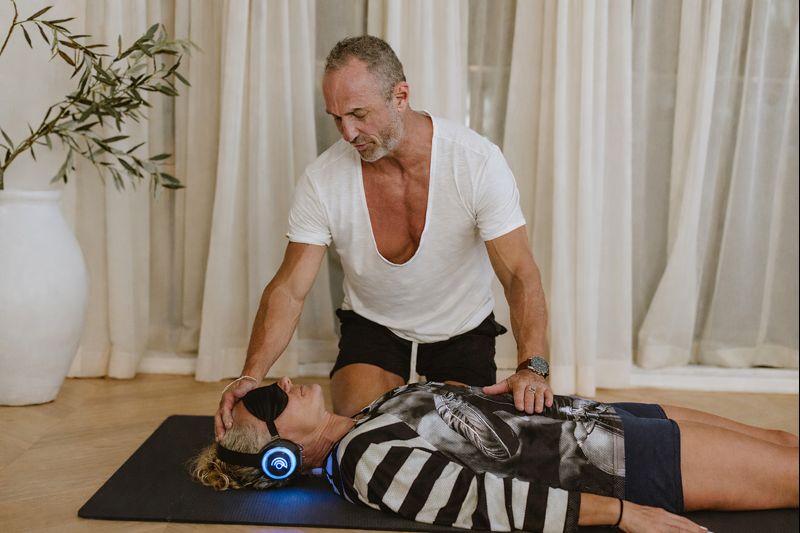
What Breathwork Actually Does To Your Body
What Breathwork Actually Does To Your Body
Something quietly significant is happening.
Across the world, in cities and clinics and retreat centres, people are lying down, closing their eyes, and breathing. Not meditating. Not exercising. Just breathing — intentionally, rhythmically, deeply — and emerging from the experience changed in ways they struggle to explain.
Breathwork has existed for thousands of years across yogic, Buddhist, and indigenous traditions. But in 2026 it has crossed into the mainstream in a way that feels genuinely different. Not a trend. More like an arrival.
"Search interest in 'breathwork benefits' has increased by over 1,000% on Instagram in 2026 alone. It is one of the fastest-rising wellness search terms globally"
The question worth asking is not whether breathwork works. The science on that is increasingly clear. The question is why — right now, at this particular moment in history — so many people are finally ready to find out.
What Is Actually Happening in the Body
When you breathe consciously — altering the rhythm, depth, and pattern of your breath — you are doing something most interventions cannot: directly communicating with your autonomic nervous system.
The autonomic nervous system governs the processes your body runs without your permission. Heart rate. Digestion. Hormone release. The state of activation or rest you inhabit at any given moment. It is the system that keeps you in low-grade fight-or-flight when life is relentlessly demanding — and the system that, when properly signalled, can return you to genuine safety and calm.
Most approaches to stress and emotional regulation work top-down. Therapy, journalling, mindfulness — they engage the thinking mind first and hope the message reaches the body. Breathwork works bottom-up. It bypasses the mind entirely and speaks directly to the nervous system in its own language: rhythm and sensation.
The physiological effects are well-documented. Slow, deep breathing activates the vagus nerve — the longest nerve in the body, running from the brainstem through the heart and gut — which triggers the parasympathetic response. Heart rate drops. Cortisol decreases. The body moves from threat detection into rest and repair.
But that is only the beginning of what breathwork does.
The Emotional Layer
The body holds what the mind protects.
Years of managed emotion — the grief that was not convenient to feel, the anger that was not safe to express, the fear that had to be set aside so life could keep moving — do not disappear. They are stored. In the chest, the belly, the jaw, the shoulders. In the breath that has quietly shortened over years without anyone noticing.
Intentional breathwork creates a doorway. As the nervous system releases its grip, stored emotion often follows. Not dramatically — though sometimes it is dramatic. More often it arrives quietly. A tightness in the chest that softens. Tears that surface without a clear story attached. A sense of spaciousness in the body that had been absent so long it had been forgotten.
For many people, a single breathwork session is the first time in years — sometimes decades — that they have experienced genuine, embodied calm. Not the performed calm of managing well. The real kind. The kind that lives in the body rather than the mind.
Why Couples Are Doing This Together
Breathwork is powerful alone. Alongside someone you love, it becomes something else entirely.
The shared experience of releasing — of allowing oneself to be seen in a moment of genuine vulnerability — creates a quality of intimacy that is almost impossible to manufacture through conversation or effort. The usual presentations dissolve. The careful management of how one appears, even to a long-term partner, softens.
What remains is often described the same way by couples who have experienced it together: we remembered each other. Not who we perform ourselves to be in daily life. Who we actually are.
This is why breathwork has become a cornerstone of the Elysia experience. Not as a technique or a session on a schedule. As an invitation. A held space in which two people can arrive at something truer than what daily life usually allows.
Why 2026 Is the Year
The surge in breathwork interest is not coincidental.
Chronic nervous system dysregulation — the persistent low-level stress that underlies burnout, relational disconnection, and physical depletion — affects the majority of working adults in high-functioning societies. Most have no name for what they are experiencing. They simply feel tired in a way that sleep does not fix.
Breathwork offers something that the wellness industry has largely failed to deliver: genuine physiological change, without technology, without medication, without requiring years of practice before results arrive. A single session can shift the nervous system in ways that are immediately felt.
People are not searching for breathwork because it is fashionable. They are searching for it because something in them already knows that what they are carrying needs somewhere to go.
The breath has always been there, waiting.
The question is simply whether you are ready to let it do its work.


.avif)
-compressed.webp)
-compressed.webp)
